.avif)
.avif)
.webp)
If you lead a GTM org right now, you’re probably living in a weird dual reality.
On paper, the mandate is familiar: Hit bigger numbers. With leaner teams. In a more challenging market.
Rosalyn Santa Elena, who helps lead RevOps School at Pavilion, summed it up bluntly: in this environment, businesses “need to do more with less, double down on efficiency and effectiveness, and optimise resources, especially from a people and budget perspective.”
The human reality underneath that?
Reps are working late nights and weekends and still wondering if they’ll hit quota. Managers are stuck in an endless loop of forecast reviews, fire drills, and “quick questions.” And whether you’re the one enablement person trying to support an entire sales team or running a global enablement org, you’re the one everyone expects to fix it magically.
It’s taking a toll. One 2024 report from Saleshealthalliance.org found that 70% of sellers say they struggle with mental health. A 2022 Gartner survey of tech sellers cited 89% reporting chronic stress. As Ben Salisbury, a former tech sales rep turned career coach, put it, “More pressure doesn’t drive performance—it just drives burnout.”
Call it AI sales enablement, call it “modern enablement”—whatever label you use, the job has never been harder. We’re trying to use AI to help our teams sell better, but most of what’s out there focuses on tools rather than people.
At the same time, AI is everywhere. Your team might already have:
- An AI note-taker in every call
- AI writing outbound
- AI that’s helping with forecasting or pipeline inspection
And yet, if you’re honest, most days still feel like a grind.
So the question I care about—and the one this piece is wrestling with—is: How do we design an enablement engine that uses AI to make sales more human and less stressful, not just more “efficient”?
I’m writing as someone who’s spent years in B2B tech marketing and sales enablement, worked in a pressure-cooker environment, and now spends all day thinking about how GTM teams can use AI without breaking their people—both as a practitioner and as a builder of AI tools.
What Is People-First AI Sales Enablement (Not Tool-First)?
.webp)
For a long time, “enablement” meant:
- New hire bootcamps
- Quarterly training days and product-launch focused training
- SKOs
- A content library that keeps growing
- Some coaching, if managers have time
There’s nothing inherently wrong with that. It’s just no longer sustainable for the world we live in, where people have reached their limit for consuming information, reps working harder and context-switching more than ever as they deal with growing buyer committees and buyer experience breakdowns, and each manager must oversee more staff.
The leaders I see making real progress treat enablement as a living, evolving system, not a calendar of trainings. In the current AI era, we now have the opportunity to flip enablement on its head, where:
- Knowledge building, skill development, and reinforcement of lasting behavioral change are continuous and occur in the flow of work rather than being reactive or bolted on.
- Feedback and coaching (both from human leaders and AI) are grounded in real data, based on orders of magnitude more observation points across many deals (hundreds or thousands of calls and emails, not just a handful of anecdotes) or manager opinions.
- Pipeline review meetings are used to conduct individual deal inspections and drive momentum. “With AI-generated insights, teams can have more effective weekly meetings where, rather than just doing a top-down review of the pipeline, they can dive into individual deal inspection, look at conversation sentiments, risks, and discuss action steps”, says Liam Weedon, Founder at GTM Layer.
- Enablement’s job is no longer about creating and pushing content – it’s about reducing cognitive load for sellers and setting up an infrastructure to make self-directed (rep-directed) learning and Q&A frictionless.
In an AI era, the “people-first” part really matters for three reasons:
- AI amplifies whatever operating model you already have.
Winning by Design talks about this as “process first, AI second.” If your GTM processes are fragmented or overly focused on activities, AI just helps you do the wrong things faster. - Sustainable performance is now a board-level issue.
Burnout, rep churn, and manager attrition will show up in board-level metrics: slower ramp rates, lower win rates, and shaky NRR. Neuroscience research on burnout is clear: chronic stress literally impairs learning and performance. People-first enablement uses AI to remove noise so teams can sustain high performance over quarters, not just brute-force one good Q. - Modern reps expect autonomy, not command-and-control.
Top performers don’t want to be watched; they want to be supported. People-first enablement uses AI to give reps more agency—self-coaching, peer learning, better decision support—while still giving leaders the visibility they need.
Whether you’ve got a full enablement function or you are the function, that’s the mindset shift: from “enablement = more teaching and training” to “enablement = designing a better system for humans.”
Mapping Your AI Sales Enablement Operating System
.webp)
Before we talk about where to plug in AI, we need a clean picture of the system it’s going into. I like to break an enablement Operating System (OS) into four parts:
- Deal motions
- New logo, expansion, and renewal motions
- How you actually move through discovery, evaluation, consensus-building, commercials, and implementation
- Where deals tend to stall or go sideways
- New logo, expansion, and renewal motions
- Coaching rhythms
- 1:1s, team meetings, pipeline reviews, deal strategy sessions
- Where coaching really happens vs where we say it happens
- How much energy goes into proactive development vs last-minute triage
- 1:1s, team meetings, pipeline reviews, deal strategy sessions
- Content & training
- Playbooks, talk tracks, case studies, battlecards, and onboarding paths
- Which assets actively show up in live deals (not just in your LMS, HighSpot, or Notion workspace)?
- Playbooks, talk tracks, case studies, battlecards, and onboarding paths
- Data & signals
- CRM fields, call transcripts, email threads, product usage, activity data
- What’s captured, what’s missing, what’s duplicated, who can see what
- CRM fields, call transcripts, email threads, product usage, activity data
Then ask this one simple question for each section: Where are people feeling the most stress and friction right now?
From your people, you’ll likely hear variations of:
- Rep: “Pipeline reviews feel like a performance review, not a working session.”
- Rep: “I never know if I’m spending time on the right deals.”
- Sales Manager/Director: “I’m coaching on the same issues over and over, but nothing reinforces it day-to-day.”
- Enablement Manager: “We have good content; reps just don’t find it or trust it’s current.”
This exercise is fruitful whether you’re a 5-person sales org with no dedicated enablement function, a solo enablement professional, or a 300-person, multi-region GTM org with a whole enablement department. It gives you a shared map for your sales enablement strategy in the age of AI. At the leadership level, this mapping matters because gaps in each area show up in metrics we get asked about:
- Deal motions affect win rate, cycle time, and ACV
Coaching rhythms affect ramp time, mid-performer lift, and forecast accuracy. - The quality of content and training—and how well it sticks—affects the sales cycle length, your ability to hold price, and how likely buyers actually are to take action.
- Data & signals affect CAC payback period, NRR, and ability to run timely experiments.
Once you see your enablement OS this way, AI and enablement investments stop being “nice experiments” and become levers directly tied to metrics like ARR per rep and NRR.
Four AI Sales Enablement Levers That Actually Help Humans
.webp)
AI can do a ridiculous number of things. But from a sales enablement lens, I’d group the value into four key levers.
Today, there’s a lot of focus on AI for prospecting, but very little through the rest of the pipeline. “Using intelligence to identify signals at every step, after every conversation, can have a significant impact on deal velocity,” says Liam Weedon, Founder at GTM Layer.
1. Reduce Cognitive and Administrative Load
The great thing AI does is help sales enablement shift it up a notch and deliver on higher impact goals. “Through automation, you can unlock capacity and decrease administrative load, but with AI, we can start to see where that extra capacity should be going, and what the high-value activities really are,” says Liam.
Here are a few examples of AI-powered automations that go beyond AI note-taking:
- Suggested or auto-populated CRM fields based on meeting transcripts (key stakeholders, risks, situation, problem, impact, event, decision-making process, next steps).
- Auto-generated deal preparation tips: “Here’s what happened, what’s changed, and what’s next. Our other reps used the following approaches to win deals similar to yours.”
For a small team with no enablement headcount, this can be the difference between reps spending their evenings logging notes and actually resting. For a large company with multiple regions and segments, it’s the difference between managers reading random snippets vs walking into 1:1s with a clear view of what really matters.
Time back is important, but it’s not just about hours; it’s about mental bandwidth.
2. Improve Decision Quality at Every Level
I posit that AI can improve decision quality at every level, moving it from “assistant” to “force multiplier.” AI serve as an a revenue forensics analyst.
For reps:
- Which deals look most like past wins or losses?
- Which stakeholders did other reps who worked similar deals in the past engage with, and how?
- What’s the highest-leverage next step in this motion and this segment?
For managers:
- Where should you spend your limited coaching time this week?
- Which “healthy” deals are actually at risk based on buyers’ language /call details and engagement patterns?
- Which types of deals tend to stall? What are the decision-making patterns of buyers we are winning vs. those we aren’t? Are there key differences?
For execs:
- Which motions (e.g., mid-market new logos vs enterprise expansion) are really working?
- Where should we double down, and where should we cut our losses?
- What’s truly behind changes in win rate or NRR?
Winning by Design talks about building a “Lean Revenue Factory” where process comes first, and AI then helps you optimize throughput. That’s ultimately what this lever is about: using AI to help humans make better, faster judgments in how they sell, coach, and invest.
3. Scale Development and Coaching
Empowering reps to own and drive their own development is the lever I’m most excited about.
Historically, coaching meant a manager jumping on live calls and giving feedback during or after. With the rise of conversation intelligence tools, some managers now review a handful of calls each week—but it’s still a tiny fraction of what’s really happening in the field.
With good data design, AI can help reps:
- See how their discovery process compares to that of top performers on similar deals.
- Get suggestions for questions, positioning, or mutual action plans grounded in actual wins and losses.
- Experiment and learn privately, without every gap becoming a public pipeline-review moment.
For managers, AI can do more than just summarize calls; it can:
- Surface a few high-signal calls or moments worth coaching so they don’t have to wade through hours of recordings.
- Highlight specific strengths and gaps by rep or team.
- Support consistent coaching instead of “whoever shouts loudest gets the most help”.
And there’s an equity angle here I don’t want to gloss over: not everyone gets the same informal mentoring, sponsorship, or air time. A system that codifies your best patterns and makes them available to everyone is quietly powerful for underrepresented folks on the team.
4. Buyer Journey Optimization

For RevOps teams, AI can help you design a smoother buyer journey. “In RevOps, we talk about reducing friction and building deal momentum. AI can take us a lot further than we could before and help us accelerate growth by uncovering the friction points and crafting a more ideal buyer journey,” says Liam.
Liam also offered a theory and an opportunity to GTM teams to test: “The answers you need are there in the seller/buyer conversations. My simplified theory is this: If you had the perfect buyer journey, the number of meetings above baseline (Discovery, Demo, etc.) would be 0. All the questions answered, objections handled, next steps agreed and actioned. Whatever is happening in those follow-up meetings is what is “wrong” with your sales process.”
Put all four levers together—less grind, better decisions, more scalable development and buyer journey optimization —and you get something deceptively simple: a healthier team that shows up better for buyers.
Who Owns Your AI-Enabled Sales Enablement Engine?
Once you start thinking about an AI-enabled enablement engine, the ownership questions come fast:
- Does Sales own it? RevOps? Enablement? Product Marketing?
- Does AI “live” in RevOps, in a central AI/insights group, or embedded in sales?
There isn’t a universal correct answer, but someone needs to own it:
- The design of your enablement OS
- The roadmap for where AI plugs in (and where it doesn’t)
- The change management so this becomes how you work, not another tool on the shelf
In smaller companies, that “someone” is often a RevOps-plus-Enablement hybrid. In larger orgs, I’ve seen success when a cross-functional GTM council (Sales, RevOps, Enablement, Marketing) owns the enablement OS design, with a clear single owner accountable for delivery.
And whatever you do, keep a couple of guardrails:
- No secret surveillance. Be explicit about how AI is used (and not used) in performance decisions.
- AI suggests; humans decide. The role of AI is to surface patterns and options, not to “score” people as good or bad sellers.
This applies whether you’re a 25-person company with a RevOps+Enablement hybrid or a large enterprise.
How to Prioritize Your Next AI Sales Enablement Experiments
Most of us don’t need more ideas. We need a sane way to pick the next move.
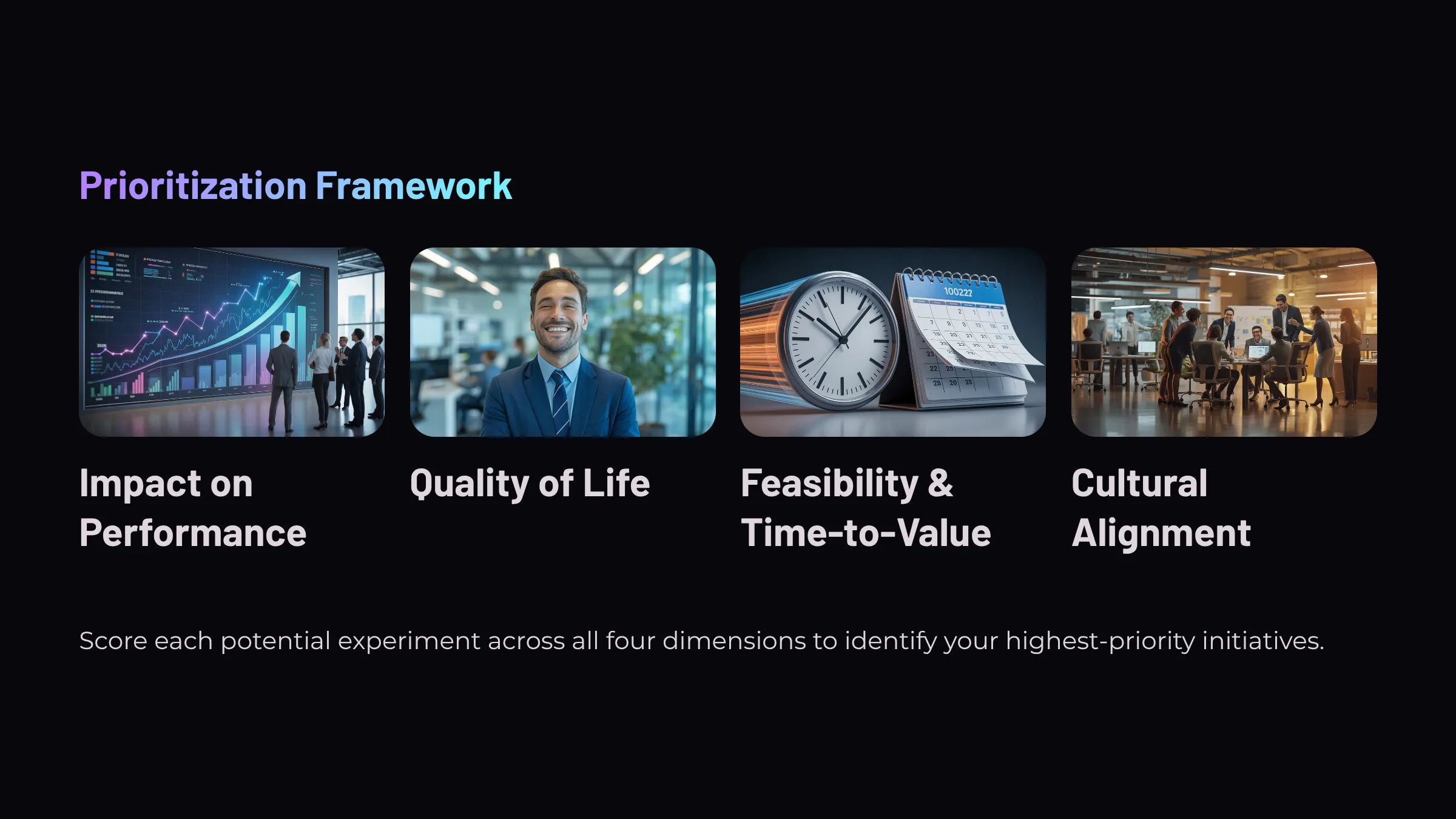
A simple prioritization grid I like:
- Impact on performance
- Will this materially move win rate, cycle time, ramp, or NRR on a key motion?
- Will this materially move win rate, cycle time, ramp, or NRR on a key motion?
- Impact on quality of life
- Will reps and managers feel this as less busywork, less stress, and less guessing?
- Will reps and managers feel this as less busywork, less stress, and less guessing?
- Feasibility / time-to-value
- Can we test this in 60–90 days with a defined scope?
- Can we test this in 60–90 days with a defined scope?
- Cultural fit
- Does this move us closer to the culture we want? Or does it erode trust?
- Does this move us closer to the culture we want? Or does it erode trust?
Concrete examples of good “first moves”:
- For a small organization
- Implement AI note-taking and basic field extraction (automatic data entry in the CRM) for a single core motion (e.g., mid-market new logos).
- Use templates and structured prompts to generate email follow-ups and deal-specific documents.
- Implement AI note-taking and basic field extraction (automatic data entry in the CRM) for a single core motion (e.g., mid-market new logos).
- For a larger organization:
- Roll out AI-generated “deal briefs” for managers and execs, so you spend pipeline time on decisions, not recaps.
- Pilot a self-serve “deal health + coaching suggestions” view based on your own win/loss patterns for a specific segment.
- Roll out AI-generated “deal briefs” for managers and execs, so you spend pipeline time on decisions, not recaps.
Define success up front:
- Quantitative: time saved, win rate on the motion, ramp on new reps, meeting-to-opportunity conversion, etc.
- Qualitative: rep and manager sentiment—does this feel like help or like monitoring?
Use that data to decide whether to scale, tweak, or stop. And there’s no shame in killing experiments that don’t land—that’s what a healthy experimentation culture looks like.
I also hear a few recurring questions when I talk with GTM leaders about AI in enablement, so I’ll tackle those quickly here.
Frequently Asked Questions About AI Sales Enablement
1. What is AI sales enablement?
AI sales enablement is the use of artificial intelligence to support how your revenue teams learn, sell, and get coached. It goes beyond basic automation by using data from CRM, calls, and emails to deliver better coaching, content, and deal guidance in the flow of work.
2. How can AI sales enablement reduce seller burnout?
By automating administrative work, improving deal prioritization, and giving reps self-serve coaching, AI can reduce context switching and decision fatigue—two major contributors to seller burnout.
3. Where should I start with AI in my sales enablement strategy?
Start with one motion (for example, mid-market new logos) and one or two use cases. Measure time saved, deal outcomes, and rep sentiment before expanding.
Smarter and Kinder Enablement
Here’s the heart of it for me: AI shouldn’t just make your dashboards smarter. It should make your teams’ lives better and your buyers’ experiences more human.
A people-first enablement engine uses AI to:
- Take unnecessary work off people’s plates.
- Improve decision quality at every level.
- Give more people access to good coaching, not just a lucky few.
- Create room for the kind of honest, thoughtful conversations that actually win deals.
If you’re reading this as a GTM or enablement leader, I’ll leave you with two questions you can take into your next staff meeting or quiet working session:
- Where does our current enablement model actually add to the grind—for reps, managers, or enablement itself?
- What is one AI-enabled change we could pilot in the next 90 days that would clearly reduce stress and improve performance for a specific motion?
We don’t control the economy, the board targets, or every buyer’s budget cycle. But we do control the environment our teams sell in—and designing that environment to be both high-performing and humane might be one of the most critical leadership decisions we make in this next chapter.
.avif)
.webp)